Board portraits · executive communications
Board of Directors & Leadership Portrait Photography India
A board portrait set has to do more than flatter individuals. It needs to make different leaders, schedules and locations feel like one credible leadership team.
A practical planning page built around how the final photographs or films will actually be used.
What strong briefs get right
Four decisions that improve the final visual library.
These are the recurring signals we found across specialist pages, official guidance where relevant, and TAT’s own corporate production experience.
Start with usage
The right photographs depend on where they need to work after delivery.
Plan categories, not random shots
Leadership, people, operations, environment and detail need deliberate coverage.
Build consistency
Light, colour, crop and naming should make images feel like one company library.
Leave room for real life
The strongest corporate images often happen between the planned frames, not only during posed setups.
Planning sequence
A useful production process is simple enough to follow under pressure.
The workflow changes by assignment, but the order matters: define the use first, then engineer capture and delivery around it.
Use case
Start with where the final visuals will live.
Coverage map
List the people, spaces, operations and stories required.
Production
Group efficient setups without making every frame feel staged.
Edit system
Create a consistent visual language, crops and naming standard.
Reuse
Distribute the library across reports, PR, web, social and internal teams.
Add first-party proof
Use images that explain something, not placeholders that merely look good.
Both slots stay hidden until Codex or WordPress replaces the comment with a real image, video or iframe.
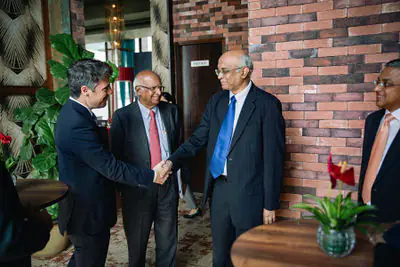
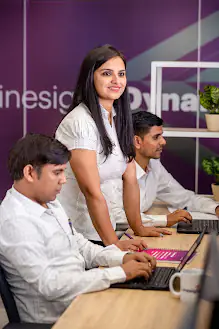
Suggested media 2: A grid showing how one portrait style can stay consistent across multiple leaders.
TAT field note
Senior rooms reward preparation more than elaborate production.
Leadership photography often has very little tolerance for wasted time.
Across high-stakes corporate, diplomatic and conference environments, TAT has repeatedly had to work around senior stakeholders whose schedules move faster than the production plan.
Pre-light the space, agree framing in advance and know the minimum set of variations before the executive walks in.
A ten-minute session can still produce a useful leadership library when the production decisions were made before those ten minutes started.
Decision table
Translate the brief into production decisions.
Use this as a conversation starter with communications, HR, PR, event, AV or brand teams.
| Decision | What good planning looks like | Common failure | TAT recommendation |
|---|---|---|---|
| Leadership | Board, CEO, leadership portraits | Annual report, media, investor material | |
| People | Teams, collaboration, employee moments | Careers, LinkedIn, internal communication | |
| Operations | Facilities, process, work in action | Reports, sales decks, stakeholder communication | |
| Environment | Office, plant, venue, branded details | Website, presentations, PR and archives |
How we think about the work
Useful beats decorative.
The photograph is not finished when the shutter closes. It is finished when another team can actually use it: in a press release, annual report, website, LinkedIn post, investor deck or internal story without having to decode what happened.
Agree the real business use and priority people.
Watch what happens between the scheduled moments.
Deliver an organised set another team can immediately understand.
Build a useful first brief.
No visible line-item pricing. This tool simply packages the decisions that most affect scope and sends them to TAT.
Continue planning
Related Tell-a-Tale Studios pages.
These links move from the planning question into the most relevant service or portfolio context.
Research-informed page: the source map supplied with this pack lists the live specialist/official pages reviewed for this topic. Competitor claims are not copied into this page.
People Also Ask
Direct answers before you request a quote.
The questions are written conversationally so they work for human buyers and answer engines without hiding the practical caveats.
01How long does an executive portrait usually take?
Once lighting is ready, a focused session can be short. The total production time includes setup, testing and any environment or group variations required.
02Can you set up inside our office?
Yes. A mobile portrait setup can be built in a meeting room, office or other suitable controlled space, subject to room size and access.
03How do you keep portraits consistent across different days?
Document the lighting, camera position, lens, background, crop and retouching approach, then use central post-production.
04Do you provide environmental portraits as well as headshots?
Yes. Environmental portraits can add leadership context for profiles, annual reports and editorial use.
05Can portraits be formatted for press releases and speaker profiles?
Yes. Plan both tight crops and frames with usable negative space so the same session supports multiple channels.
06Do you photograph leadership teams outside Mumbai?
Yes. TAT is Mumbai-based and travels for selected corporate assignments across India.
Share the brief. We will recommend the smallest team that can do it properly.
Send the date, location, timings, audience, priority stakeholders, intended use and delivery deadline.